Sunday, 16 September 2012

George Best at 19

This photograph by Neil Libbert goes on display in the National Portrait Gallery tomorrow. It accompanied an interview in the Sunday Times back in 1965 by Hunter Davies, who recalled events in May 2002 for the New Statesman:
I first interviewed him in 1965. I was doing the Atticus column on the Sunday Times, just at that moment in time when the world changed, or at least my world changed: the Sixties had arrived and I was at last able to stop interviewing boring bishops and masters of Oxbridge colleges and talk to real people, like northern novelists, pop stars and footballers.
George was aged 19, a naive young lad with a strong Belfast accent and Beatles haircut. He was in the first team at Man Utd, but still living in digs, polite and deferential, worried that the older players in the dressing room would tease him about his haircut and the flash new jacket he'd just bought. He had arrived at Old Trafford aged 15, then run away, homesick, to Belfast. "I thought I'd never make the grade. It was my father who talked me into coming back." He still seemed a bit in awe of senior players such as Denis Law and Bobby Charlton, whom he had hero-worshipped as a kid.
At the age of 19, he didn't drink or smoke, so he told me, and I believed him. "Well, perhaps on rare occasions I might have a lager. Then it gets back to the boss, Mr Busby, that you're drunk. I would like to have a flat of my own, but the boss thinks there might be temptation. Perhaps, when I'm 21. I've no complaints. I like my landlady."
1965 was the year Manchester bands achieved three successive US Number 1 singles: Freddie and the Dreamers with 'I'm Tellin' You Now'; Wayne Fontana and the Mindbenders with 'Game of Love'; and Herman's Hermits with 'Mrs. Brown, You've Got A Lovely Daughter'. The rest of the Hunter Davies column can be seen here.

Saturday, 15 September 2012

Old Trafford and Russian Constructivism

I've just finished reading the Manchester chapter in Owen Hatherley's A Guide to the New Ruins of Great Britain and was really struck by this passage about getting to Salford:
You could cross [the Irwell] via the swanky bridge designed by instant regenerator Santiago Calatrava but to get the true measure of the place it's best approached through the bleak dual carriageways, retail parks, office complexes and industrial estates of Trafford, where you get to see the bizarre Yeltsin-Constructivism of Old Trafford Stadium, redesigned by local architects Atherden Fuller in the late 1990s. This freakish mix of domineering symmetries and bared structure is heralded by a statue of Denis Law, George Best and Bobby Charlton, the United Trinity locked in embrace. Their faithfully rendered skinny bodies and skimpy 1960s kit contrasts vividly with today's lumbering soccer supermen, leaving them looking dainty and rather camp, with a slight mince to their celebratory pose.
I Googled the phrase "Yeltsin-Constructivism" to find out what it meant and came across what must have been an earlier draft of the same paragraph, in which he talks about "the bizarre Yeltsin-Constructivism of Old Trafford, where domineering symmetries, bared structure and outrageously kitsch statues prove the enduring ridiculousness of the world's least interesting football team."

It's worth pointing out that in the book itself, Hatherley makes clear his apparent lack of interest in football-in-general when he complains about the conversion of the Urbis building into the National Football Museum: "It's difficult to imagine any fate more depressing."

Luckily, what Hatherley appears to lack in interest in football (and its role in the city's regneration), he makes up for in his architectural descriptions. He appears to be the only person to ever have used the term "Yeltsin-Constructivism" and what a great, unique way to describe what is probably Manchester's most iconic and important building, the centre of a global commercial empire and (despite what Hatherley appears to think) probably the most enduring narrative in world football.

It makes you wonder whether the architects consciously had the idea of some sort of postmodern 1990s form of Russian Constructivism in mind when they redesigned the stadium. Whilst there is no record (on Google) of anyone using the term "Yeltsin-Constructivism," there is a group called the New Constructivists, whose aim is to explore constructivism's "stylistic relevance to the contemporary world in terms of the use of line, planes, precision and formal ordering of visual elements."

This wouldn't have been the first time Manchester United have been associated with the imagery of the Soviet Union, and I don't mean the Red Army's 1974 "plan to invade Manchester." United fans have long referred to themselves as the Red Army. The Republic of Mancunia has recently become a popular slogan, with its attendant image of clenched fists and red stars (not to mention the occassional hammer and sickle). In a recent article on the football website In Bed With Maradona on Manchester United's left-wing tendency, I suggested that this may have stemmed from the industrial character of the area around Old Trafford (visited in 1961 by the cosmonaut Yuri Gargarin).

It's hard to imagine any other area in the UK making such a play on this perceived left-wing identity - "red" in more than one sense of the word. The irony is obvious and many have pointed it out in response to the IBWM article. The club whose fans align themselves with the imagery (if not necessarily the politics) of the far left (possibly reflected in the design of the stadium), are also famously successful at global marketing and closely identified with huge sponsorship deals with the likes of insurance giants AON, car manufacturers Chevrolet, logistics firm DHL and watchmakers Hublot. A far cry (as Hatherley seems to be hinting at) from the innocent world of Law, Best and Charlton, modest salaries and sponsorless shirts.

Football is the global sport and Manchester United are its common currency. Its brand strategists have successfully tapped that huge market and Old Trafford is the symbolic centre of what I earlier described and what can only be described as an empire. It stands alongside the Nou Camp, the Bernabeu and the San Siro as a monument to European club football's global dominance. With the term "Yeltsin-Constructivism," Owen Hatherley may have summed up its unusual aesthetic.

Thursday, 13 September 2012

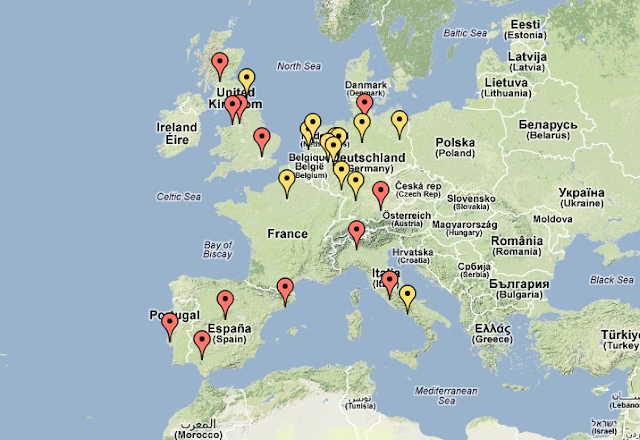
A football map of Europe (avg attendances)

This map shows the 12 biggest derbies in Europe (marked in red), based on combined average attendance figures for both clubs throughout the season, where a derby is defined as a match between two clubs whose stadiums are within 5 miles of each other.* The yellow markers show the 13 individual clubs with the highest average attendance who didn't make the list.

*The 5 mile criteria allows us to define Arsenal vs. Spurs as a derby but not Arsenal vs. Chelsea (whose stadiums are 6.4 miles apart). Of the derbies (outside London) which would have made the list had the distance criteria been different, Newcastle United vs. Sunderland (10 miles apart), Hertha Berlin vs. Union Berlin (14 miles apart), Borussia Dortmund vs. Schalke (17 miles apart), the Berlin derby is the only one-city derby, but the combined average attendance of the Revierderby would make it the largest in Europe.

Click on the map or here to zoom in and see the figures.

Sunday, 9 September 2012

Manchester derby the biggest in Europe

Europe's biggest derbies by combined average attendance 

1
Manchester United
75,387
Manchester City
47,044
122,431
4
2
Real Madrid
74,836
Atletico Madrid
45,236
120,072
4
3
FC Barcelona
78,340
RCD Espanyol
26,826
105,166
3.3
4
Milan
51,442
Internazionale
47,913
99,355
0
5
Celtic
50,904
Rangers
46,324
97,288
4
6
Arsenal
60,000
Tottenham Hotspur
36,026
96,026
3.8
7
Bayern Munich
69,000
TSV Munchen 1860
22,898
91,898
0
8
Liverpool
44,253
Everton
33,228
77,481
0.6
9
Benfica
42,464
Sporting CP
34,490
76,954
1.4
10
Hamburg SV
53,465
St. Pauli
23,220
76,685
3.6
11
Real Betis
37,405
Seville
35,684
73,089
2
12
Roma
35,240
Lazio
32,444
67,687
0
13
Chelsea
41,478
Fulham
25,293
66,771
1.4
14
Aston Villa
33,873
West Brom
24,793
58,666
3.3
15
VfB Stuttgart
55,090
Stuttgarter Kickers
3,561
58,651
3.3
16
Juventus
37,545
Torino
15,897
53,442
4.7
17
Feyenoord
44,605
Sparta Rotterdam
7,089
51,694
4.2

The table above shows Europe's biggest derbies based on combined average attendances throughout the 2011-2012 season (i.e. not just for the derby matches themselves but for all matches). I've defined a derby as a match between two teams whose stadiums are within 5 miles of each other. With a combined average attendance of 69,573 the derby between Hertha Berlin and Union Berlin would have made the list but the clubs' stadiums are 14.4 miles apart. I would be very interested to know if there are other derbies which people think would make the list based on these criteria. The stadiums of Borussia Dortmund and Schalke are 17 miles apart but their combined average attendance of 141,739 would make it the biggest derby in Europe. Newcastle United and Sunderland have a combined average attendance of 89,030 but their stadiums are 10 miles apart.